

Your Body’s Early Warning System
A 3-minute diagnostic to identify where political stressors are landing in your body, before they overwhelm your nervous system.

Dear friends
In last Tuesday’s conversation, we began to unpick the ABC model — the understanding that a generally invisible filter of beliefs, thoughts and assumptions (B) sits between the things that happen to us in the world (A) and the emotional consequences we feel as a result (C). We talked about how this “B” is assigned by our minds to give our world its meaning. However, for many of us, even attempting to find that middle step feels like a significant, perhaps even impossible, task. We want to find a steadier footing, only to realise that we simply do not have the mental capacity to do so right now.
That’s understandable: it feels like we have spent the last eighteen months holding our breath. The weight of Trump’s second term has become a physical atmosphere. It is the low hum of anxiety when the phone pings, the way we brace ourselves before opening a news app, and the quiet, corrosive weariness that comes from wondering which part of daily life will feel less certain today.
Most of the time, our beliefs are like a film score — they are playing in the background, dictating the mood of the scene, but we are so focused on the action that we don’t even hear the music. We only realise something is wrong when we find ourselves mid-spiral, feeling the “C” of the ABC sequence: the anger, the frustration, the anxiety, the dread. In this kind of environment, our “B” — our internal beliefs and assumptions — are being triggered dozens of times a day as a survival mechanism. It’s exhausting.
When we feel utterly drained, our minds constantly scanning for every possible threat, asking ourselves to suddenly “think differently” can feel like an impossible task.
Instead, might we simply sit with the idea that our bodies often know we are in trouble long before our conscious minds?
That familiar, sharp tightening in the chest or the way the breath hitches when you see a particular name in a headline — these physical twinges aren’t just passing responses. They are our early warning system, the first messengers telling us that the mind has just filtered an event and assigned it a meaning that the nervous system finds threatening.
Today, I’m not asking for you to make any big shifts in perspective — we are not going to try to change our thoughts or “fix” our reactions. We are simply going to practice the art of noticing our physical responses.
For this coming week, our task is to start treating these physical sensations as a gentle “ping” of awareness. If you can learn to say to yourself “Ah, my heart is racing because I’ve just told myself a story about what this news means,” you have created a tiny, vital sliver of distance. By focusing on your body, you ground yourself in the present moment, which is the only place where you can actually find our footing.
You may think this is a very small thing, but in a world that feels as though it is constantly pressing in on us, that tiny gap can be a sanctuary. It allows you to be a whole person who is observing a reaction, rather than just being determined by the reaction itself.
This is how you find a small, quiet space inside the storm. It respects the gravity of what you are navigating while offering a tangible way to stop your nervous system from being quite so overwhelmed by every passing wave. It moves you out of the role of the person being swept away by the wave, and into the role of the person who sees the wave forming.
Make no mistake: this is nothing short of a small, quiet, and deeply radical act of reclamation.
3 Minute Body Scan
This practice is about becoming an investigator of our own physical sensations. Research into interoceptive awareness1 — the ability to sense our internal state — suggests that this type of systematic check-in is essential for long-term emotional resilience.
You can do this quick ‘mapping’ exercise while sitting or standing. I’d recommend doing it once now, to gauge your “baseline”, and then at any point during your day when you feel a shift in your mood.
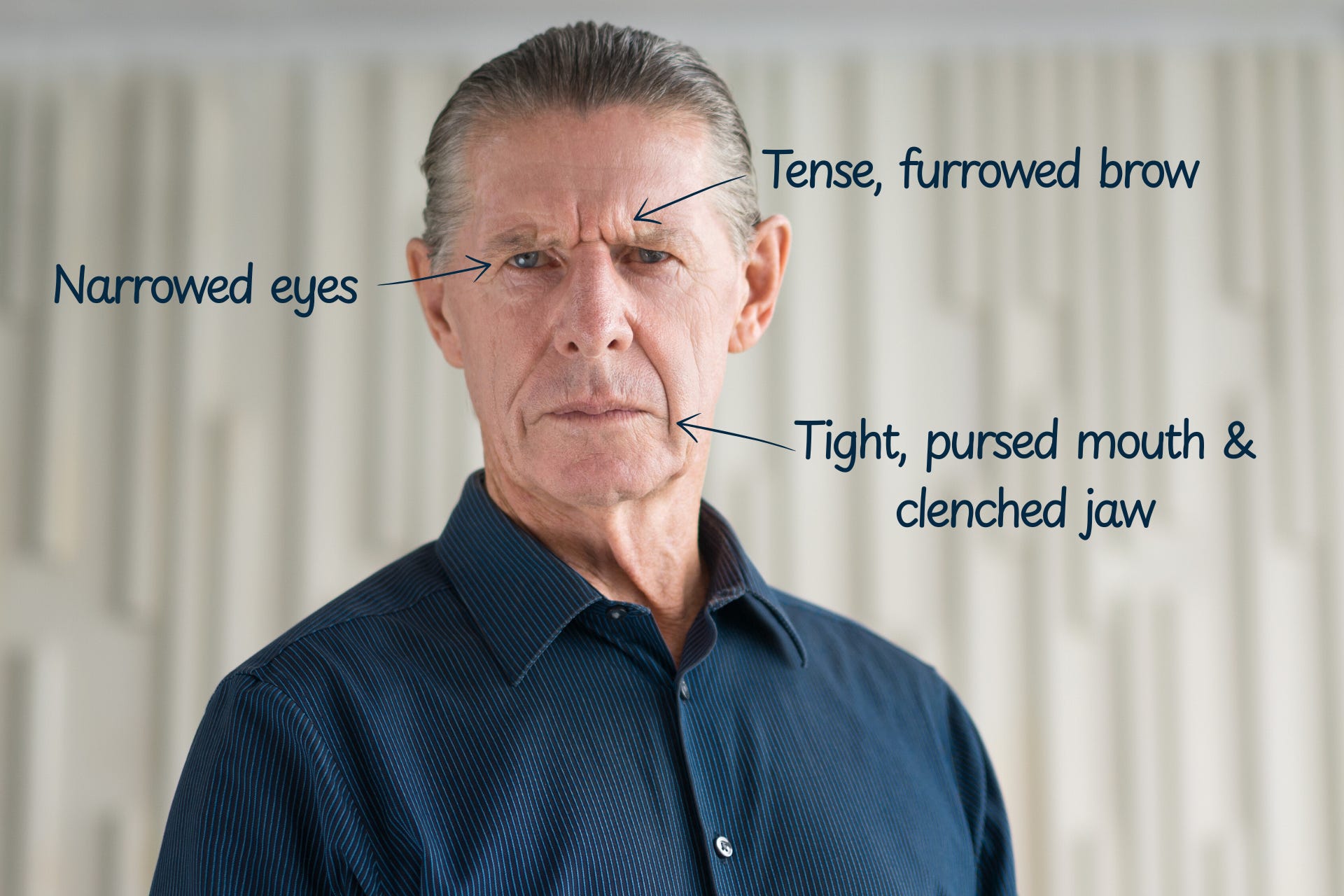
Research shows that our facial muscles are often the first to respond to a perceived threat, creating a feedback loop between our expression, and our emotional state. Bring your attention to your forehead and the space between your eyebrows. How does it feel in this moment? Does it feel knotted, furrowed, or pulled tight? Perhaps there is a sense of heaviness or pressure here. Or does it feel smooth, expansive, and relaxed? You are simply noticing what is present, without trying to change it.
Moving your attention to your eyes, notice if the muscles around the sockets feel hard or strained, as if you are squinting to see a problem more clearly. Then let your awareness move to your jaw. Is it clenched tight? Are your teeth pressing together, or is there a space between the upper and lower teeth? Are your lips pursed or held in a thin line? The jaw is a primary site for holding tension related to resistance or the need to “brace” ourselves. By recognising the state of our jaw, we are identifying a clear physical indicator that an internal “alarm” has been tripped.
Slowly move your attention down to the tops of your shoulders and the back of your neck. Do your shoulders feel raised, as if they are trying to reach your ears? Do they feel rigid and “armoured,” or do they feel dropped and heavy? Notice the muscles at the base of your skull — do they feel strained or tight? For many of us who have been under sustained pressure, this area becomes a permanent “holding zone” for the weight of our responsibilities and concerns. Recognising this tension allows us to see that a belief about our burden has been activated.
Shifting your focus to the centre of your chest, observe the movement of your breath. Does your chest feel tight, as if there is a band constricting it? Does your breathing feel shallow, staying high up in chest and collarbones? Or does your chest feel open and the breath move easily? When our internal filters perceive a crisis, the body naturally restricts the breath as part of the survival response. Studies show that becoming aware of this restriction is a key step in interrupting the cycle of automatic reactivity.
Now, bring your awareness to your upper abdomen. Does your stomach feel knotted, hollow, or “fluttery”? Is there a sense of “sinking” or “flipping” in the gut?
Finally, check your hands — are your fingers curled into a grip or a fist? Are your knuckles white from tension, or are your palms open and soft? The gut and the hands are often where our most visceral reactions to news or conflict are stored.
Taking the time to sit with these physical sensations is a profound act of self-compassion. It is a way of acknowledging the weight we carry in a world that rarely asks us to pause. We are living, breathing people whose systems require quiet and care to function, especially when the atmosphere around us feels so charged. This gentle awareness is a necessary step toward finding a more sustainable way to exist in these taxing times.
I will be back on Friday to share my first piece on herbal supplements. We will look at how a specific plant ally can help to soothe a nervous system that has been stretched thin, offering a bit of physiological support alongside the mental work we are doing. I often find that when our bodies feel a little more supported from the inside, the external world can feel just a fraction less overwhelming.
I look forward to welcoming you back then. In the meantime, I hope you find the space to be kind to yourself as you navigate the rest of your week.
In solidarity, as ever
— Lori
© Lori Corbet Mann, 2026
Price, C. J., & Hooven, C. (2018). Interoceptive Awareness Skills for Emotion Regulation: Theory and Approach of Mindful Awareness in Body-Oriented Therapy (MABT). Published in Frontiers in Psychology. https://pmc.ncbi.nlm.nih.gov/articles/PMC5985305/
About the Author:
Hi, I’m Lori, the writer behind Your Time Starts Now.
I learned authoritarianism the hard way. Eleven years in Zimbabwe under the Mugabe regime taught me that our most vital infrastructure isn’t the power grid or the economy — it is the human nervous system. When the world becomes volatile, our biology is the first thing to be weaponised. If we cannot regulate our anxiety, fear, and moral outrage, we will lose our ability to think, discern, and act with integrity.
I’ve spent twenty-five years at the intersection of nervous system regulation and mind-body medicine, learning how to stay functional when external safety disappears. I write for those who stand against the same authoritarian patterns now emerging in the West and want a strategy for resilience that goes deeper than “just breathe”. I offer a map for staying grounded, capable, and ethically clear-headed in a time of accelerating pressure.
If this sounds like something you’d welcome, I warmly invite you to subscribe.

Thank you so much. I have cPTSD on top of my physical disabilities and this constant state of hypervigilism is exhausting. I've been working hard on noticing when my shoulders are up by my ears and my whole body is tense, but I feel like that 99% of the time so it's really tough. I'm constantly holding my breath and I had no idea why, but now I do. Thank you for being a voice of reason during this chaos ❤️
Thank you, Lori, for your generous work on the behalf of others. I for one will remain deeply grateful and always hold you in my heart💔 ❤️💖❤️🩹❣️