

This Was No George Washington Moment
The Venezuelan opposition leader’s claim of “brotherhood” masks a reality of submission that may reverberate through the Western Hemisphere

Dear friends
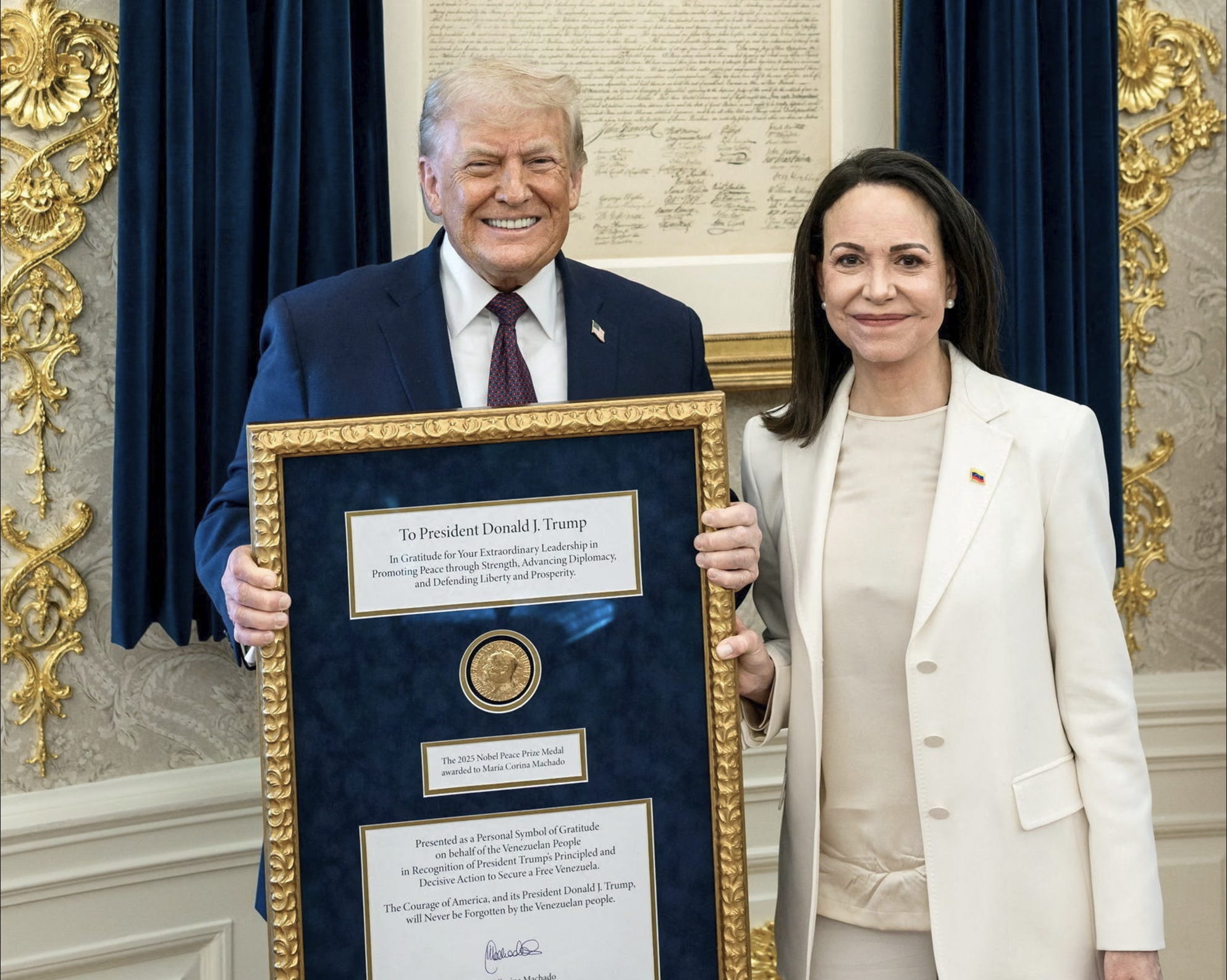
When María Corina Machado — the Venezuelan opposition leader — presented her medal for the Nobel peace prize medal to Trump this week, she compared the action to how, in 1825, the Marquis de Lafayette sent a gold medal featuring an image of George Washington to the South American independence hero Simón Bolívar1. It was a powerful rhetorical move, intended to frame President Trump’s intervention as the continuation of a grand historical lineage. But if we look closely at the actual circumstances of 1825, the parallel she draws is deeply flawed.
While both events involve the transfer of a gold medal between revolutionary figures, the power dynamics and the meanings behind them are almost diametrically opposed.
In 1825, the Marquis de Lafayette — the French hero of the American Revolution — sent a gift to Simón Bolívar, who was then at the height of his power as the “Liberator” of South America. The gift was not a prize that Lafayette had won himself. It was a package containing a portrait of George Washington, a lock of Washington’s hair, and a gold medal bearing Washington’s likeness.
Crucially, Lafayette was acting on behalf of Washington’s family, who viewed Bolívar as the spiritual heir to the American Revolution. In his accompanying letter, Lafayette wrote that of all men alive, Bolívar was the one to whom Washington would have wanted to offer his hand.
The circumstances of this 1825 exchange were defined by mutual admiration between peers. Bolívar had just led successful wars of independence across a continent, freeing Colombia, Venezuela, Ecuador, Peru, and Bolivia from Spanish rule. The United States was not intervening in his wars; it was watching from afar with respect. The gift was an acknowledgement that the torch of republican liberty had passed from North to South. It was a gesture of equality, linking the first successful revolution in the Americas (1776) to the second (1810–1825).
By contrast, the circumstances of 2026 are defined by intervention and dependency. Machado is not giving President Trump a commemorative token of a past hero; she is giving him her own Nobel Peace Prize — a personal accolade earned for non-violent resistance. More importantly, she is doing so in the immediate aftermath of a US military invasion that removed her political rival. Unlike Bolívar, who liberated his continent with his own armies, the liberation celebrated here was achieved by American special forces.
So, while Machado invokes “brotherhood”, the dynamic is closer to a tribute. In 1825, the United States honoured a South American leader for what he had achieved independently. In 2026, a South American leader is honouring an American President for what he did to her country.
The Lafayette gift was a recognition that South America could stand on its own; the Machado gift is an acknowledgement that it can not.
By surrendering her prize, Machado is trying to recreate the symbolic link between Washington and Bolívar, positioning Trump as the new “Liberator”. However, the historical reality of 1825 was about shared republican values and the rejection of imperial control. The reality of 2026 — where a foreign superpower installs a transitional government and extracts resources — bears little resemblance to the “brotherhood” Lafayette described. It looks far more like the very imperial dynamics that both Washington and Bolívar fought to destroy.
But the historical inaccuracy is arguably the least dangerous aspect of this exchange. By reframing a unilateral military intervention as a supreme act of "brotherhood" worthy of the world’s highest honour, Machado may be doing more than simply flattering Trump. She may, in fact, be providing the ultimate moral validation for a leader who already struggles to distinguish between his own will and the rule of law.
In my forthcoming essay, I’ll be sharing how this short-sighted act of tribute may inadvertently green-light a dangerous escalation in US ambitions. From the White House to the icy straits of Greenland, this "symbolic" exchange could have very real, very dangerous consequences for the stability of the Atlantic alliance. I am currently researching and writing that deep dive — keep an eye out for it in the coming days.
In solidarity, as ever
— Lori
© Lori Corbet Mann, 2025
It's a bribe and it won't help her a bit.
I’m curious about the sentiment among the Nobel committee.