

Noem's not been ousted — she's been PROMOTED
The appointment of Kristi Noem as Special Envoy for The Shield of the Americas signals a step up, not back

Dear friends
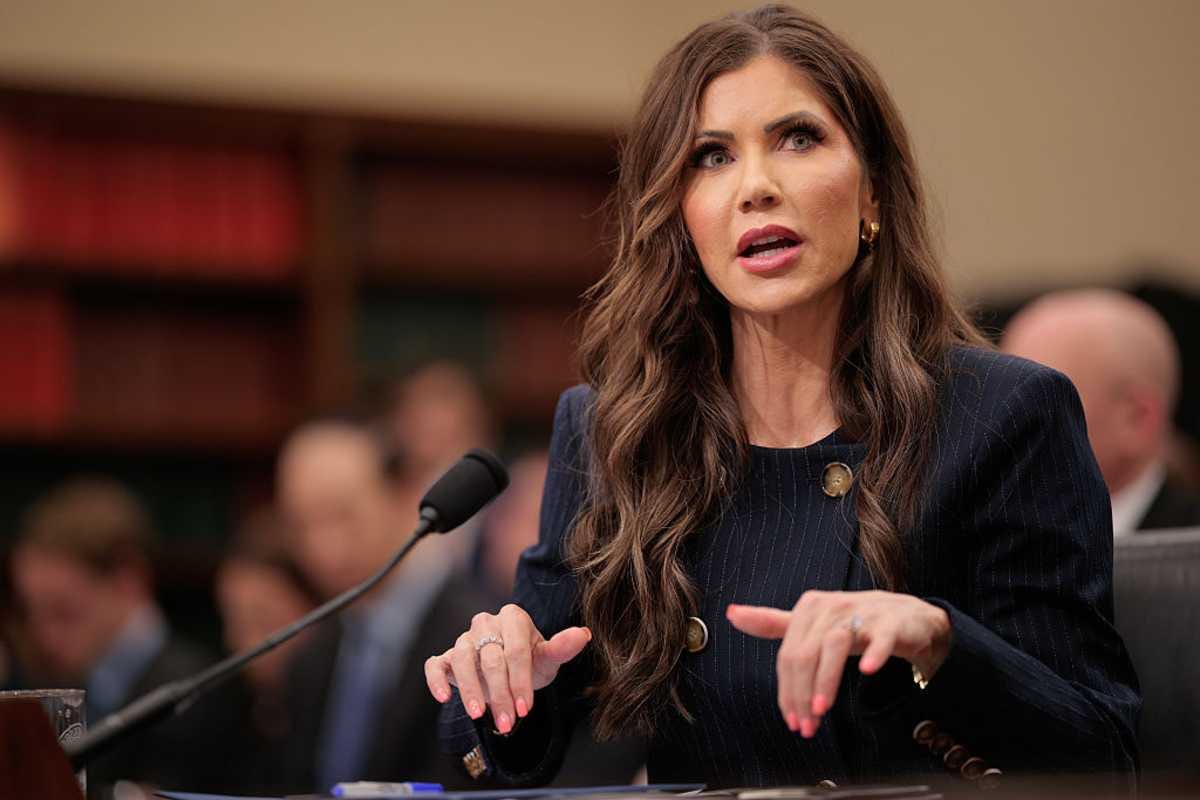
Today the media is full of reports that Kristi Noem has been fired. While the news focuses on her perceived disgraces, I believe the reality is that Donald Trump is rewarding her for her evident loyalty. I have set aside my planned post for today because this move is far from a simple dismissal.
On 5 March 2026, Trump removed Noem from her position as the Secretary of Homeland Security. Senator Markwayne Mullin from Oklahoma has been chosen to take over the role on 31 March 2026. The events that have been used to justify her removal are many, including the deaths of two citizens at the hands of Federal agents and the controversial use of $220 million in government funds for advertisements.
Noem was giving a speech to police officers when the news of her firing was shared on social media. She later wrote a message online to thank Trump for her new role as “Special Envoy for The Shield of the Americas”. This essay explains why Noem’s move is actually a promotion.
The “Shield of the Americas” Summit
The “Shield of the Americas” summit is a major diplomatic event scheduled for tomorrow, Saturday, 7 March 2026. It will be held at the Trump National Doral resort in Miami, Florida. The summit is intended to formalise a new security and economic bloc — a group of countries that work together — composed of nations that are closely aligned with the “America First” agenda of the United States.
Attendees: The summit focuses on what the administration calls "pro-Washington" leaders.
Confirmed attendees include Javier Milei of Argentina, Nayib Bukele of El Salvador, and Daniel Noboa of Ecuador. Other leaders expected to attend are José Raúl Mulino of Panama, Santiago Peña of Paraguay, and Rodrigo Chaves of Costa Rica. Luis Abinader of the Dominican Republic, José Antonio Kast who is the President-elect of Chile, and Rodrigo Paz of Bolivia will also be there. The list is completed by Nasry Asfura of Honduras, Mohamed Irfaan Ali of Guyana, and Kamla Persad-Bissessar who is the Prime Minister of Trinidad and Tobago.
Leaders from the three most populous nations in Latin America — Brazil, Mexico, and Colombia — are not expected to participate.
The summit agenda: The primary goal of the summit is to establish a minilateral group, a small and focused alliance of nations who can act quickly on United States priorities.
One key topic is the administration’s plan to provide financing for ports, energy grids, and highways. This is intended to reduce the influence of Chinese investment in the region. A "rip and replace" policy will be discussed to remove Chinese-made telecommunications equipment (such as Huawei) and replace it with technology from the United States.
The group may also establish “secure port” certifications and common rules for trade. These measures are designed to protect the production of medicine, semiconductors, and critical minerals. Furthermore, the United States will encourage its partners to share information regarding the activities of Russia, Iran, and China in the Americas.
The focus of this essay is the plan for drug enforcement — an area where Kristi Noem will now feature. In her new role as Special Envoy, she will focus on a “big agreement” regarding drug enforcement, working closely with Rubio and Hegseth to dismantle drug cartels across the entire Western hemisphere.
This role is likely to place Noem at the centre of a massive international security project that bypasses the domestic bureaucracy of her former department.
Counter-narcotics as a cover for regime change
In recent months, the American government has changed how it interacts with its neighbours in the Americas. Instead of using traditional diplomacy, it is now using the fight against drugs as an excuse to intervene in the politics of other nations. The 2026 National Defense Strategy now treats drug trafficking as a direct attack on the United States, even labelling fentanyl as a weapon of mass destruction — a term normally reserved for nuclear or chemical weapons. Using it in this context is intended to create a justification for the American military to operate in the Americas just as they once did in the Middle East.
This strategy relies on specific legal labels to bypass international standards. By designating criminal groups and foreign leaders as members of Foreign Terrorist Organisations, the American government claims it has the right to use military force against them. The administration uses this framing to act without the permission of the United Nations or other international bodies. It also uses these designations as a reason to seize money and property belonging to these leaders. While the official story is about stopping drugs, the actual intention is for the United States to control who runs these countries.
Venezuela
In January 2026, the United States launched a military mission in Venezuela. American special forces and intelligence officers entered the country and captured its leader, Nicolás Maduro. The Trump administration described this as a law enforcement action, charging Maduro with drug trafficking and narco-terrorism. By framing the capture as an arrest for a crime, the administration created a narrative intended to shield the action from being classified by the international community as an invasion or an act of war.
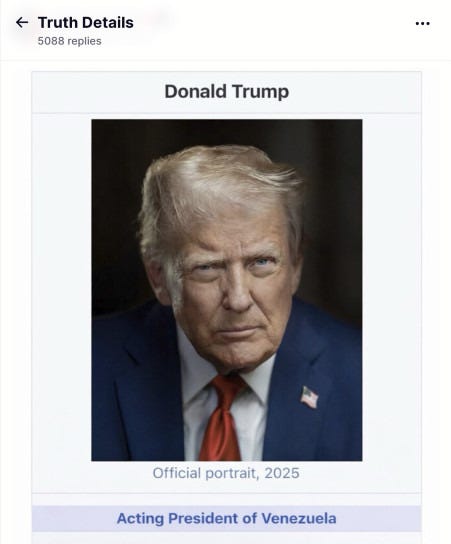
In Venezuela, the Trump administration has suggested it will run the country until a new government is formed that it likes. The aim of this intervention is to ensure that leaders in the region are friendly to American interests and willing to let American companies access their resources, such as oil. This was further highlighted when Donald Trump posted an image of himself to social media with the caption “Acting President of Venezuela” shortly after the operation.
The Trump administration is applying similar pressure to Colombia, Mexico, Cuba, and Canada. They are using the argument that these countries are either unable or unwilling to stop the drug trade to justify interfering in their internal affairs.
Colombia
In Colombia, the Trump administration has focused on President Gustavo Petro. In late 2025, the United States placed him and his family on a sanctions list, accusing him of being a leader of the drug trade — without providing evidence. This appears to be a deliberate attempt to weakens Petro’s political standing before the 2026 elections. The Trump administration is using the high levels of coca produced in Colombia as a reason to demand that Colombia changes its laws and allows the American military to operate there.
Mexico
In Mexico, the American government has changed how it labels criminal groups, having designated several drug cartels as Foreign Terrorist Organisations. They have also labelled fentanyl as a weapon of mass destruction. The Trump administration is using these labels as an excuse for the American military to plan strikes on Mexican soil. The goal of this pressure is to force the Mexican President, Claudia Sheinbaum, to follow American orders or risk seeing her country become a battlefield for American troops.
Cuba
The Trump administration does not label Cuba as a major producer of drugs in the same way it does with Colombia or Mexico. Instead, it uses a "narco-terrorism" narrative to link the Cuban government to the criminal charges it has brought against the leadership in Venezuela. The administration argues that by supporting the "narco-state" in Venezuela, Cuba is effectively a hostile regime, and part of a criminal network that threatens American safety.
Cuba depends on Venezuela for much of its oil. Since the American military now controls parts of Venezuela, the United States has cut off these oil shipments. The American government is combining this economic pressure with the narco-terrorism narrative to push regime change in Cuba, without admitting it is a political intervention. They have told Cuban leaders to make a deal or face consequences, which many believe refers to a military operation.
Canada
The American government is applying similar pressure to Canada by framing the northern border as a major security threat. In 2025, Trump declared a national emergency and claimed that Canada was failing to stop the flow of fentanyl into the United States. To “punish” Canada, the American government has imposed high tariffs on Canadian goods that started at twenty-five percent and have since increased to thirty-five percent.
By labelling fentanyl as a weapon of mass destruction, the Trump administration has created a pretext to use military resources to intervene at the border. It argues that Canadian laboratories are producing the drug and that the Canadian government is choosing not to stop them. This is used as a justification for the United States to take direct action inside Canada.
While Canada has traditionally been a close ally of the U.S., the Trump administration now treats it as a subordinate, having pressured Canada to increase military spending and to change how it sets the prices for medicines to favour American companies. Mark Carney, has tried to resist this, but the United States continues to use economic threats and sanctions to force a change in how Canada is governed. The ultimate goal is to ensure Canada remains a source of natural resources while ensuring its government follows American policies.
The return of the Monroe Doctrine
To understand these current events, it is necessary to look back at the Monroe Doctrine, a policy first set out by President James Monroe in 1823. At that time, the United States declared that any attempt by European powers to interfere in the Americas would be seen as a hostile act. While it began as a way to protect newly independent nations from old empires, it has often been used by the United States to justify its own influence over its neighbours.
In late 2025, the administration introduced what it calls the “Trump Corollary”, a new policy that explicitly states that the United States will reassert its dominance in the Western Hemisphere to protect its own security and access to resources. By reviving this old doctrine, the American government is claiming a legal and moral right to act as the primary authority for all nations in North and South America.
Kristi Noem’s new title as the Special Envoy for The Shield of the Americas — Western Hemisphere puts her in a position within this strategy. By moving from a cabinet office into this envoy role, Noem is being positioned as a primary official in the administration’s regional strategy. A Special Envoy often reports more directly to the President or the Secretary of State, which would allow her to focus exclusively on this international initiative. The stated goal of this project is to dismantle cartels, but it also provides a framework for the American government to ensure that the policies of its neighbours remain aligned with its own interests.
This change in role suggests that Noem will now be a lead representative for a strategy that uses the fight against drugs as a reason to intervene in the internal affairs of other countries. While the full extent of her new powers will be made clearer at the summit tomorrow, the administration is already presenting her as a central figure in this new “Donroe Doctrine”.
Despite the narrative being presented by the media — that we have seen the end of Kristi Noem’s influence — her new role suggests she will be a key figure in the events to come. We must pay much closer attention to what is unfolding here, as the consequences for the U.S.’s neighbours may be significant.
In solidarity, as ever
— Lori
© Lori Corbet Mann, 2026
References:
The Associated Press: 8.09GMT Noem reacts to her ouster 8.13GMT What is ‘The Shield of the Americas?’ Reports on Trump’s announcement of Noem as the "Special Envoy for The Shield of the Americas" and her Nashville speech mentioning the "big agreement" . https://apnews.com/live/kristi-noem-markwayne-mullin-trump#0000019c-bf9e-dc4b-adbe-ffbeee0e0000
L.A. Taco: This report details that Noem’s new role as "Special Envoy for the Shield of the Americas" is specifically designed to draft and lead an agreement focused on "combating cartels and drug trafficking in the entire region." https://lataco.com/donald-trump-reassigns-kristi-noem
Peoples Dispatch: Details the “Shield of the Americas” summit in Doral and the “Doral Charter,” describing it as a tool for American dominance in the region. Describes Noem as overseeing the upcoming summit and the signing of the Charter. https://peoplesdispatch.org/2026/03/06/trumps-regional-allies-to-gather-in-miami-for-shield-of-the-americas-summit/
Department of Homeland Security Official Statement: A press release titled “Thanks to President Trump and Secretary Noem, America is Safer,” which praises her record and confirms her transition to the new Envoy role. https://www.dhs.gov/news/2026/03/05/thanks-president-trump-and-secretary-noem-america-safer
Livemint / NPR: Coverage of the Nashville law enforcement event where Noem outlined the upcoming anti-cartel strategy for the Western Hemisphere. https://www.livemint.com/news/us-news/what-is-the-shield-of-the-americas-kristi-noem-named-special-envoy-in-new-security-initiative-11772742835551.html
The Independent: Confirms that Noem intends to join the President and other top officials at the summit in Doral this Saturday: https://www.independent.co.uk/news/world/americas/us-politics/shield-of-americas-kristi-noem-envoy-b2932947.html
The phrases, "America First," and, "U.S. interests" sound all fine and good. But they are ill-defined. Back when Condi Rice was running around, the, "interests" term appeared to mean, "Big Oil." Since so many pharmaceuticals are petrochemical derivatives, by extension, that would have included Big Pharma. Now, Big Pharma would extend to Big Insurance.
But currently, the term seems to have come to mean, "Big Tech." AI is merely a part of that.
As an American, living n the USA, I don't believe my interests are served, by being fleeced to subsidize "Big" anything. These giants can afford their own costs of operation.
I foresee real danger, ahead, for Americans traveling abroad. The resentment raised by what these ill defined terms do, will play out as anti-American hostilities, putting American travelers in real danger.
It would be interesting to have a non-political, independent group, do a survey, to find out what the average American views, as in their interests, and as putting our nation first. When I casually inquire, I get a wide, wide, array, of answers. Beyond a generic fear of foreign attacks, (which may well be manufactured, as they seem constant), I'm not finding any overall consensus. Just tons of variety.
So good Beautiful. You were so brilliant here. I do think she’s a scapegoat. Because the man writing the policy and sending ice into communities is Stephen Miller. He’s still there.